Thursday, 31 July 2014

Bitter Sweet

Joe has served Mbita, Kenya for the past 11 years and Daneen for over a year now.  Departures and transitions are often bitter sweet; filled with sadness over the things and people you will miss, but equally filled with excitement for the future and a new adventure.  As we finish our commitment here and prepare to return home to America in August, there are numerous things we will miss about this place and our lives here, and other things we won’t.

What We Will Miss the Most About Living in Kenya:
-  Big avocados and mangos for a really cheap price
-  Seeing the development of the young children; academically, athletically and in their character
-  The generosity and hospitality of the Kenyan people
-  The community centered culture where everyone works together whether it’s raising children, herding cows, or sharing food.
-  “Harambee”.  In Kiswahili, it means: “pull together”.  In times of need and tragedy, everyone comes together to help others
-  The smiling faces of the little ones
-  Watching the football girls Joe helped develop as they play for their secondary schools
-  Hearing a little voice shout out, “UNCLE JOE” or “AUNTIE DANEEN” as we walk down the road
-  Competing against other schools in math exams (Joe loves winning!) 
-  Being a part of helping young disadvantaged children rise above their situations to build a better future
-  The simple life.  A simple home, simple lifestyle and little need for material “stuff”.
-  No American lifestyle (always-must-be-busy-and-doing-stuff) demands.  This allows for many quiet, restful nights at home and plenty of quality time together (great for newlyweds!)
-  Easily accessible public transportation
-  Amazing sunsets over Lake Victoria


What We Will NOT Miss About Living in Kenya:
-  Lake flies- the equivalent of gnats in America during summer but they arrive in large swarms of tornado-looking clouds from across the lake
-  Malaria, worms and amoebas
-  Living in a fishbowl- as one of the very few white people in a small town, you are like a celebrity with everyone is watching your every move
-  Death and Funerals- they are too common with an average of attending at least 1 funeral a month; often times we’re asked to use our vehicle to transport the person to/from the mortuary.  Funerals are a full-day event after a week of fundraising activities, often times including loud music played all night long, heard for miles.
-  3-4 hour long church services.
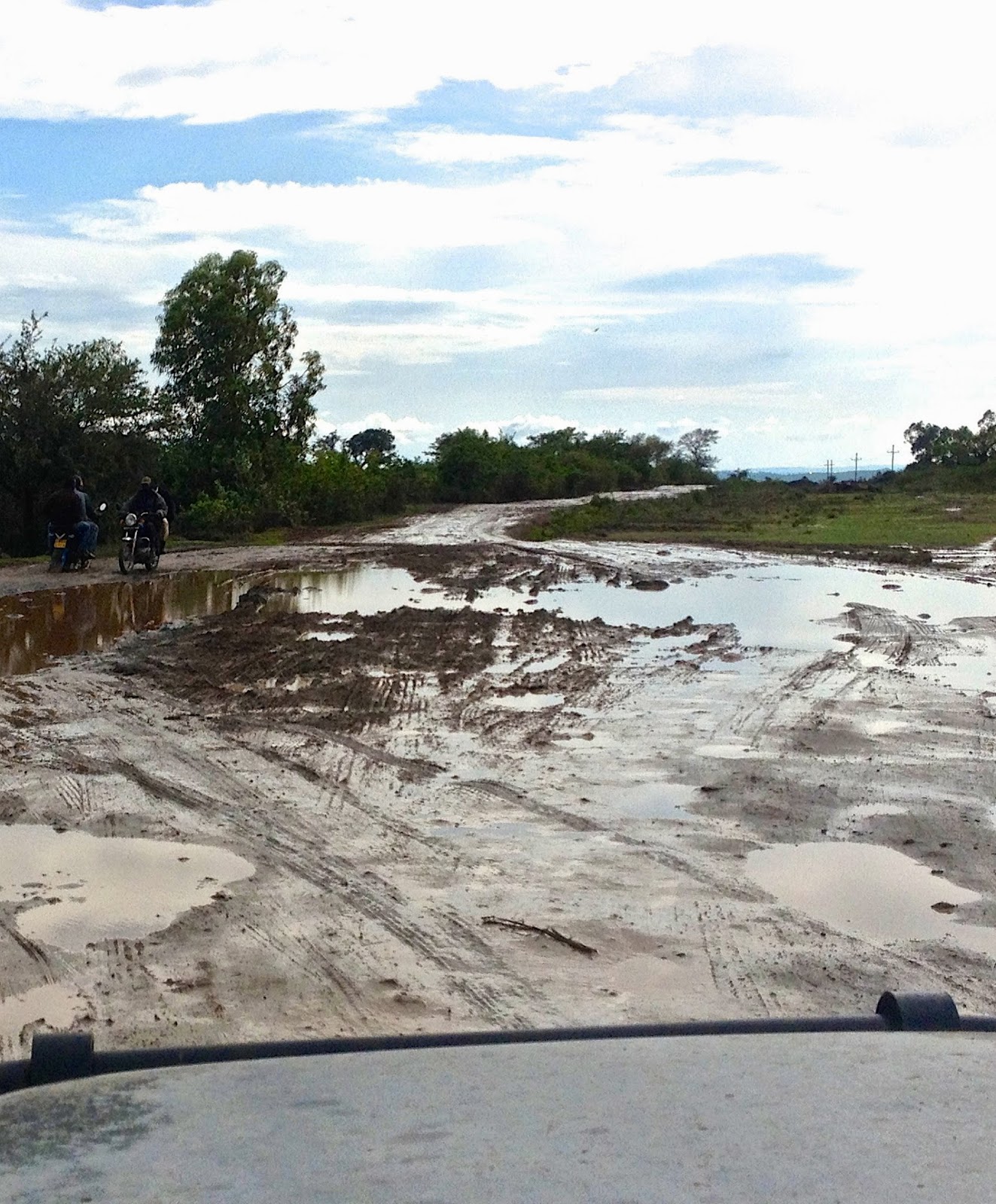
-  The Roads- so many horrible, rough, unpaved, pothole covered roads and other “roads” which are merely wide paths in between houses and farms.
-  Speed Bumps- on the nicely paved roads, there are frequent speed pumps.  Each is a different size and they’re almost always unmarked with no forewarning.
-  Cold showers on mornings when the electricity is out.
-  “Mzungu” – it’s never enjoyable to walk to the market or school and deal with people (kids and adults) shouting at you “Mzungu, mzungu!” simply because you’re different. Mzungu means foreigner or white person.
-  Corruption and bribe culture- it exists from the highest government offices and officials down to local police, hospital workers and even schools and churches.
-  Uncountable requests for financial help- as a Westerner, many see us as an opportunity to get money or other material items
-  Never knowing the whole story. Due to our lack of understanding the local language along with unspoken cultural customs and behaviors, it seems we never get the whole picture, no matter how many questions we might ask.


As with most things in life, there are always good and bad, positive and negatives, about every place on Earth.  We will really miss our home, family and friends in Kenya, but we look forward to the positive and life-giving things about the next place we’ll live; wherever God may lead us!

Tuesday, 22 July 2014

Champions at Last!

For the first 3 years of high school, Belinda Awuor and Judith Mayor have played on great teams which always reached the Semifinals in the Secondary School Regional Ball-games.  But each year they fell just short of the championship. In the first two years, they lost by a goal in the semifinals.  Last year they came even closer by drawing in regulation and in extra time before narrowly losing on penalty kicks.  That was the most painful loss because they played so well and came so close; and for Judith it was even more painful because she missed a penalty kick that could have won it for them. 


This year they were determined to become champions in their final year of high school.  Judith was named the team captain and Belinda was definitely the spiritual/emotional leader of the team.  Just like in past years, they again helped Gekomoni Secondary School cruise to easy victories in the Zonal competitions, as well as the Sub-County and County tournaments.  They reached the Regional Tournament with a lot of confidence, but even more determination 

To understand their level of determination, it is important to flashback to their childhood... 

Both girls grew up as orphans, being raised by single mothers who struggled to provide for their big families.  During primary school, Judith and Belinda both made some bad choices which brought even more challenges into their lives.  Growing up in those situations, it was difficult for them to attend school regularly which greatly affected their academic performance.  The opportunity to play football helped motivate them to stay in school.  Eventually they reached 8th Grade and were able to take the National Exams.  When they received their results, they were far below the pass mark.  Their parents/guardians, as well as the Suba Laker Club Officials, wondered if that would be the end of their education.  Since most secondary schools don’t take students with low National Exam scores, everyone was concerned that these girls might have no option except to get married at a young age and begin a family.  It is a fate that many girls in this region accept because of various circumstances.  These two girls were not ready give up though! 

Fortunately for them, they had a talent in football.  Because of their ability, a coach from Kisii called the Suba Lakers and said he would help find a school for Belinda and Judith.  Not only did he find them a school, but he also offered to pay their school fees; all because they were good in football.  They were given the opportunity to continue playing football, but more importantly, to continue in their education. 


Four years later in 2014, they are now in their final year of high school and getting one more chance to win the Championship.  In the Regional Tournament, Gekomoni dominated their pool in the preliminaries by defeating Nyahera 1-0 in the opening game and then thrashing St. Gema 4-0 in their 2nd game.  Having already won their pool, they lost a meaningless third game 1-0.   They had reached the semifinals for the fourth consecutive year.  In the Semifinals against Ugari, Judith atoned for last year’s failure by placing a free kick over the heads of the defenders which allowed the Gekomoni striker to outrun them and score a goal towards the end of the first half.  They held on for a 1-0 victory and had finally qualified for the Championship Game! 

For the Finals match, they were pitted against last year’s runners-up, Nyakach Girls High School.  Nyakach had won their pool and easily won their semifinal 3-0 which had led many people to pick them as the odds-on favorite.  Gekomoni didn’t worry about what others thought and came out fighting in the Finals, playing their best game of the tournament.  They showed more aggressiveness and created multiple opportunities to score, but the cross-bar and the Nyakach goalkeeper thwarted their efforts each time.  Judith was the team orchestrator in central mid-field, while Belinda was the defensive stopper that no ball could pass.  Eventually, the match went into extra time, but neither team managed to score.  This championship to determine which team would represent the Lake Region at Nationals would come down to post-match penalty kicks. 

The Gekomoni goalkeeper had a great tournament, only allowing 1 goal in 5 games.  She stepped up even more in the post-match penalty shootout by not only blocking 3 shots, but also by converting her own penalty kick.  Gekomoni took the trophy by winning 3-2 in penalty kicks.  The team and their fans celebrated by picking up Belinda and carrying her on their shoulders.  It was a glorious moment for both Judith and Belinda after having come up short in their first three tries. 


In early August, they will travel with the Gekomoni team to Kakamega for the Kenya National Secondary School Finals.  It will be the 3rd straight year that the Lake Region representative will be led by Suba Laker players.  If Judith and Belinda continue on with that same determination and perseverance, they will be successful at Nationals, but even more importantly, they will be able to graduate high school and be successful in life!  

Resources for Short Term Vision/Mission Teams

We've been on both sides.  
We've each been a part of short-term mission teams and we've also hosted teams, both separately and together. 

We personally find huge value in properly preparing a team (or individual) for a trip to a foreign country and culture.  We've discovered that setting a focus on learning and developing relationships rather than doing projects and seeking accomplishments has been a key to a "successful" mission trip.

Below are some great resources for individuals and teams.  These are intended to supplement a church mission trip training program. We do not suggest someone use only these resources. 


Articles: Short Term Team Preparation
Click on the title to read each article
10 Steps for Doing Short Term Missions - Whole, by Sarita Hartz. If you read nothing else, read this one!! Team leaders and each member!

When Rich Westerners Don't Know They are being Rich Westerners - Djibouti Jones, by Rachel Pieh Jones. Must read for each team member.

The Reasons We Go - by Addie Zierman. Good ideas for things to focus on during a trip.

Using Your Poor Kid to Teach My Rich Kid a Lesson - by Jamie, the Very Worst Missionary. Great thoughts focusing how we're all alike.  Especially good if children and youth are on a team. 

10 Things You Need to Know Before Going on a Mission Trip - Unexpected.org, by Melanie Dale. Great things to consider and help set your focus for a trip.

Short Term Mission Trips : Maximizing the Benefits - Mission Frontiers, by Glenn Schwartz. Short article about "being" rather than "doing".

The Good Missionary - Christianity Today, by Samuel Ikua Gachagua and Claire Diaz-Ortiz. An African orphan shares on what he loves (and doesn't) about short-term mission teams.

Please Don't Say They are Poor but They're Happy - A Life Overseas, by Rachel Pieh Jones. Tough truths about experiencing poverty.

Good Intention, Good Practice - Djibouti Jones, by Rachel Pieh Jones. This will make you think before you snap a photo!!


Articles: Short Term Teams Post-Trip Processing
Reverse Culture Shock - Team Pete, by Joe and Daneen Peterson.  Our personal thoughts on ways to work through reverse culture shock.

Rocky Re-entry - various articles and resources about the challenges of reverse culture shock and re-entry.

I Am a Triangle - Thrive Connection, by Deb Smith. Talks about how your worldview changes after an impactful trip to a foreign culture. 

A Life Overseas - Good stories about missionaries living overseas.

When Missionaries Leave the Field - Christian Standard, by Carla Williams from Team Expansion.  For long-term missionaries; not applicable to short term teams.


Training Resources for Teams:
Missions Dilemma video series ($30-50), by Steve Saint – Designed for group discussion.  Great for trip preparation meetings.

Helping Without Hurting in Short-term Missions ($12) - Leadership guide with video series. A paradigm-forming contemporary classic on the subject of poverty alleviation, specifically for short term trips. Avaliable on RightNow Media (free with subscription).

Roundtrip Missions Video Series ($20) - Various topics relative to short term missions.

Online videos from Roundtrip Missions (free) Various teaching modules on great topics.


Books:
When Helping Hurts by Steve Corbett & Brian Fikkert. Free online video sessions for group discussion. *Check out the updated version specific for short-term missions.
Africa Friends and Money Matters by David E. Maranz
A Hole In the Gospel.  6 week study guide and DVD series for groups.
- More book suggestions on topics of missions, cross-culture, international development, Africa (by country) provided here

Additional Training for Individuals:
Perspectives Class - Find a class near you.
CHE Training (Community Health Evangelism) – Holistic approach to missions. Uses a model of training nationals to train other nationals. 

Training for Long term missionaries:
Mission Training International - Compass, a 4-week pre-departure training. Learn skills to survive (and thrive) long term on the mission field. ($$$) 


This is by no means an exhaustive list.  These are resources we have personally used or teams we've hosted have used.  Please comment below or email us with your favorite team preparation resources!


Alumni Spotlight: Nicholas


Meet Nicholas.   An Alumnus who began his education at Christ’s Gift Academy in Pre-Primary (Kindergarten).  He has endured many hardships over the years including being orphaned by the age of 8 and fighting with life and death.  His perseverance, hard work and humble attitude along with this trust in God has helped him to overcome life’s challenges.  In September, he’ll be starting college.

This is his story.

~~~

You will first notice his quirky smile and friendly personality. Nicholas is quick to recognize the positive things in life and have an attitude of gratitude and joy.  He has a desire to make a great impact in this world for God’s Kingdom.

“I want to give out the potential planted deep inside me and show others that they should not only work to earn money but also to glorify their Creator.  This is [what is able] to transform our stereotyped country and see God’s Kingdom prevail.”

Nicholas’ hopes and dreams for his own life, as well as his country, did not come easily. He was born in 1992 and at the age of 6, his father passed away.  In 2000, he had the opportunity to attend CGA.  Diana, his Nursery school teacher, recalls him as "very timid and shy when he first started school, yet often happy whether he received correction or praise."  During his second year at CGA, while in 1st Grade, his mother died.  He was left under the care of his grandfather and later an aunt became his guardian in a home full of children; as many as 9 at a given time. 

In 7th Grade, Nicholas personally had to fight to stay alive.  With a terribly weak immune system, he also developed tuberculosis which debilitated him. With the assistance of CGA staff, he received the necessary treatment just in time.  Lillian, CGA’s social worker, recalls: “He was really down.  He was about to die.”  Nicholas ended up missing all of 1st term in 7th Grade (3 months of school), which is the most challenging and important time in Primary School.  For 2 months, Lillian visited Nicholas’ home 2-3 times a day, taking him food and monitoring his health.  After a long recovery process, he returned to school and had to work extra hard to catch up with his classmates, but eventually he was performing near the top of his class.  The care which CGA offered during this time was critical to his recovery and ability to be alive today.

As an orphan of the HIV/AIDS epidemic, it would have been easy for Nicholas to foster an attitude and lifestyle of a victim.  Instead, he has chosen to live with a great attitude and has worked hard to improve his life and have hope for a better future.

His church pastor describes him as being humble, organized, hardworking and reliable. “He is a team player who is able to lead others in achieving group goals.”

Nicolas performed well on his primary school final exams and earned the grades to attend the highest-performing secondary school in the district, Mbita High School.  During his time in high school he worked hard and his grades were always in the top 20% of his class.  He participated in the Environmental Club to help plant trees and flowers throughout the school compound.  The school Principal will say he was also a mentor and good example to other students. While his grades and extra-curricular activities were a great achievement, it was his spiritual development which flourished in high school.


“I accepted spiritualism [religion] during my early ages to conform with the prevailing pattern of faith-based activities at CGA.  However, these only received a tangible meaning when I encountered Christ in Form 2 [10th grade] and has continued to [grow] in the faith.”

After finishing high school in 2012, Nicholas chose to use his free time to volunteer as a teacher at a local primary school.  He enjoyed teaching so much that he has his goals set on a career as a teacher.  He applied for and was accepted to receive the CGA Post-Secondary Scholarship; a partial-scholarship to assist with the costs of college or university.  No one in his immediate family has gone to college or university.  

This September, Nicolas will continue his education at Rongo University College studying Education.  His desire after completing the 4 year degree program is to teach high school, with a specialization in Kiswahili and Christian Religious Education.

Nicholas has an enormous amount of gratitude to CGA and his sponsors.
“I wouldn’t have made any educational or spiritual growth today if there wasn’t CGA.  In addition, I have also made good progress in my health.  All these I owe to CGA; clear proof that my life would  have been different if I had never gone to CGA.”

Nicholas has always enjoyed reading and appreciated the CGA school library. He desires to someday give back to CGA by supplementing the library with more learning materials in order to help other students enjoy it as much as he did.


A final quote from Nicholas to encourage you the reader about life’s hurdles:
“With perseverance and determination coupled with complete trust in God, one can easily overcome the challenges of life.  That is one of God’s greatest gifts.”

~~~

CGA Alumni like Nicholas are a testament to the success of the ministry.  Christ’s Gift Academy is more than a primary school who supports students in secondary school.  It is a holistic ministry caring for all aspects of each child; academic, physical, social and spiritual.  Even more than a ministry, CGA is a family.  We praise God for the success stories like Nicholas and many others in the CGA family.


We've enjoyed spending time with Nicholas over the past year and are excited about his future.